Practical-Exam Wiring Rules — Two Wires per Terminal and Route-Via
The practical exam isn't only about whether the circuit works — it grades how you wired it. Start with the two rules beginners break most often: two wires per terminal, and right-angle routing.
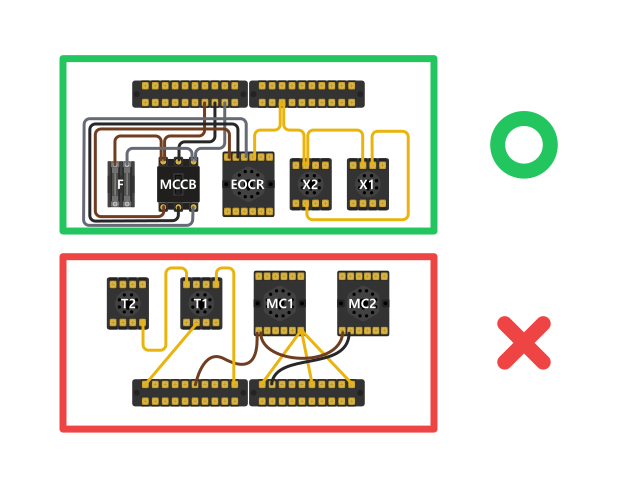
At most two wires per terminal (DQ #13)
No terminal screw may carry three or more conductors. Stacking three gives uneven clamping, which causes poor contact and heating — and it's an automatic fail when spotted.
Horizontal/vertical, right-angle only (DQ #14)
- Run straight along the horizontal lane between parts,
- turn 90° where you need to change direction,
- travel the vertical channel in the left/right 50 mm margin, then turn 90° once more onto the terminal.
- ❌ No diagonal shortcuts. ❌ No vertical run plowing between two parts.
When you need a third connection — route-via
If three points share one electrical node but the terminal is already full, route through a sibling terminal that still has a free slot.
- Fasten the new wire to a neighbouring terminal with a free slot.
- Current rides the wire already on that terminal onward to the destination.
- As a result no terminal ever carries more than two wires.
Korean trade calls this 경유 결선 (route-via). The daisy-chain analogy helps, but the term used here is route-via.
Wire-colour convention
Colour is chosen by the circuit a conductor serves, not by its endpoints.
| Category | Circuit | Wire colour |
|---|---|---|
| Main circuit | L1 | Brown |
| Main circuit | L2 | Black |
| Main circuit | L3 | Grey |
| Control circuit | control wire | Yellow |
| Protective earth | PE (ground) | Green (green/yellow) |
Common mistakes
- Forcing a third wire onto the same terminal → route it via a sibling instead.
- Picking any nearby terminal to route through → it must be a free terminal on the same electrical node.
- Colouring by endpoint → colour follows the circuit type.
Next
With placement rules and wiring rules in hand, apply them on a real problem — Public Problem 14: main circuit (motor forward/reverse). You'll see exactly where the 2-wire cap and route-via bite at EOCR's outputs.
Try it yourself
Get your wiring checked in the Korean Electrician practical simulator →