Korean Electrician Public Problem 14 — Main Circuit (Motor Forward/Reverse)
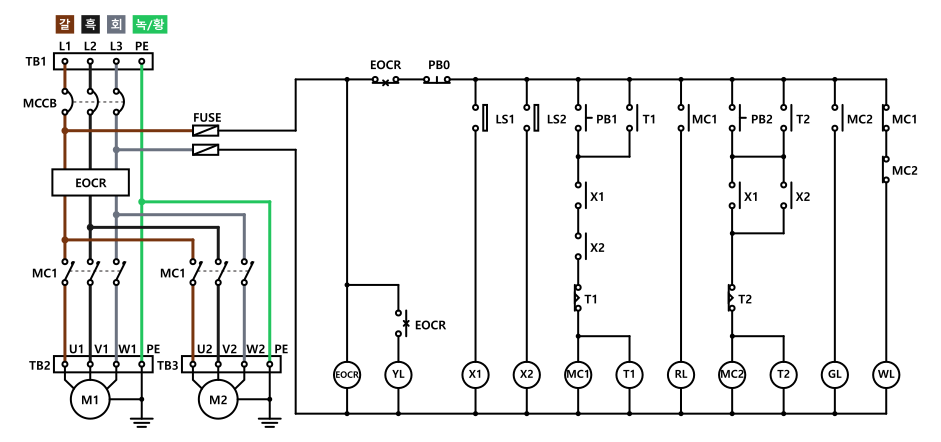
Public Problem 14 of the Korean Electrician practical runs two 3-phase motors forward and reverse, alternating automatically. The circuit splits into two layers — the path power takes to the motors (the main circuit), and the logic that decides when to throw the switches on that path (the control circuit). This guide covers the first layer only: the 22 main-circuit conductors. You've already met each part in MCCB + fuse, EOCR, magnetic contactor (MC), terminal blocks, and panel layout — here we focus on joining them into one path.
At a glance — the path the main circuit takes
It starts at POWER, runs through a shared section, then branches per motor.
- POWER → MCCB → EOCR — the service feed both motors share, through breaker + overload protection.
- EOCR → MC1 → MOTOR1 — the first branch.
- EOCR → MC2 → MOTOR2 — the second branch (same shape; a second wire lands on each EOCR output).
- PE (ground) — the safety conductor that passes through *nothing* (no MCCB, no EOCR, no MC) and runs straight from the input terminal block to the output blocks.
POWER and both motors sit off-panel, already cabled to the edge terminal blocks (TB). The main-circuit wiring is the panel-internal run that starts and ends on those blocks' panel-facing screws.
Color is set by the circuit, not the endpoints
The 22 conductors use just four colors.
| Phase | Color |
|---|---|
| L1 | Brown |
| L2 | Black |
| L3 | Gray |
| PE (ground) | Green |
Color follows which phase a wire carries, not where it runs from and to. See wiring rules for the full convention.
Max 2 wires per terminal — where EOCR's outputs fill up
The max-2-wires-per-terminal rule (disqualification #13, see wiring rules) bites hardest at EOCR's outputs. Because both motors branch from the same EOCR, pins 7·8·9 each carry one wire to MC1 plus one to MC2 — right at the ceiling.
If a third wire to the same node were needed, you don't stack a third on the EOCR screw — you route via a neighboring terminal that still has a free slot (e.g. an MC input). PE works the same way: one wire from input PE to M1's output PE, then another from there on to M2's output PE, so no PE terminal ever exceeds two.
The control supply branches off here
The last two main-circuit wires are the supply feed for the next layer (the control circuit). Control uses only two of the three phases — L1 + L3 (Korean Electrician convention). The tap point is EOCR top-1 / top-3: a second wire off each pin carries the supply into the fuse (FUSE) input.
The path is laid, but the motors won't spin yet
22 conductors in four colors complete the route from POWER to the motor terminals. But the motors won't spin even with power applied. That's because MC1·MC2's coils (the electromagnets that pull the main contacts closed) aren't powered yet. Deciding *who* energizes those coils — a push-button, a self-hold latch, a timer, a limit switch — is the control circuit.
Next
Layer the yellow control circuit onto the same panel to complete the automatic forward/reverse sequence — Public Problem 14: control circuit.
Try it yourself
Wire Problem 14's main circuit one conductor at a time in the simulator →