Korean Electrician Public Problem 1 — Full Wiring Walkthrough
Public Problem 1 of the Korean Electrician practical exam runs two motors, chosen by a selector switch (manual / auto); in auto, it is controlled by a water tank's level (a floatless relay), and a flicker relay flashes a lamp and buzzer as an alarm. Don't let the part count scare you — the backbone is a single self-holding circuit, and everything else just sits on top of it. Let's follow it through with three drawings.
At a glance — what builds what
| Role | Devices |
|---|---|
| Protection / breaking | MCCB (molded-case breaker), F (fuse), EOCR (electronic overcurrent relay) |
| Motor drive | MC1·MC2 (12-pin magnetic contactors), M1·M2 (motors) |
| Run commands | SS (selector, manual/auto), PB1 (green, start), PB0 (red, stop) |
| Aux / timing / alarm | X (8-pin relay), T (timer), FR (flicker relay) |
| Level sensing | FLS (floatless level relay) + tank electrodes E1·E2·E3 |
| Indication / alarm | RL (red lamp), GL (green lamp), YL (yellow lamp), BZ (buzzer) |
1. Device layout — what goes where
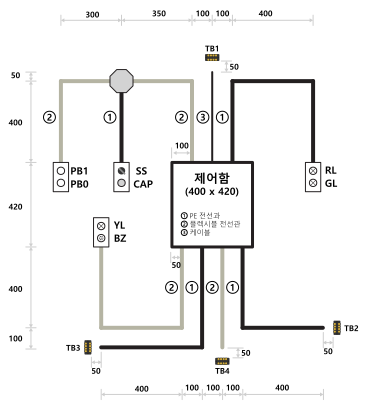
- The control box (400×420) is central; operator devices live in control boxes *outside* the panel.
- Conduit is specified in three kinds — ① PE conduit, ② flexible conduit, ③ cable. The number *is* the conduit type, so follow the ①②③ on the drawing exactly.
- Where conduits split or join, you place an octagonal junction box (J) — the only legal branch point on a conduit run.
- TB1–TB4 are field terminal blocks outside the panel; they tie the motors, supply, and operator devices back to the panel.
2. Panel interior — the parts inside the box
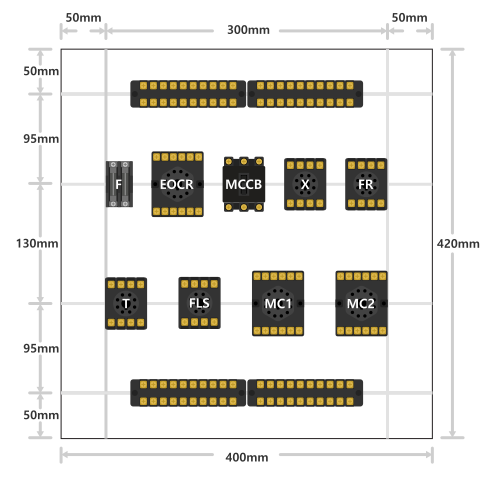
The inside is simple. Two terminal-block rows top and bottom (TB5·TB6), with two rows of parts between them.
- Upper row: F · EOCR · MCCB · X · FR
- Lower row: T · FLS · MC1 · MC2
Every wire inside the box reaches the outside world (operator devices, motors) *through* these two terminal blocks. Parts don't run wires straight out of the box.
3. The main circuit — from supply to motor
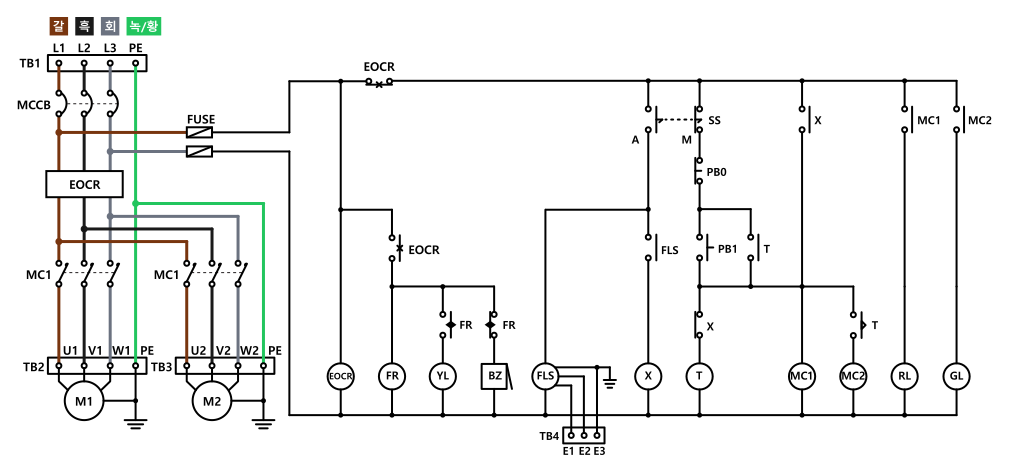
Trace the main circuit as one trunk:
- TB1 (L1·L2·L3·PE) brings in 3-phase 220 V.
- MCCB switches all three phases at once.
- EOCR watches the current — on overload it trips and cuts the control circuit.
- The supply splits to MC1·MC2, and each contactor feeds its motor, M1·M2.
Wire colors follow the main-circuit rule — L1 brown · L2 black · L3 gray, with earth (PE) green. (The control circuit is yellow.) For the full color rule, see Wire color & terminal rules.
4. The control circuit — self-hold is the backbone
The control circuit on the right looks busy, but its center is a single self-hold latch. Press PB1 to start, and relay X holds itself in through its own a-contact; press PB0 to release it (see self-holding circuits). Every other part just adds a condition to that latch.
- SS (selector) — picks manual (M) / auto (A). Manual runs from buttons; auto runs from the water level.
- PB1 (green) · PB0 (red) — start / stop. Stop is always a b-contact (NC) in series.
- X (8-pin relay) — the aux relay that takes the start signal, self-holds, and drives the contactors.
- FLS + electrodes E1·E2·E3 — three electrodes in the tank sense the water level and switch the motor on/off in auto.
- T (timer) — used for time-delayed action.
- RL·GL — not run/stop lamps, but each lit by an MC aux a-contact: RL follows MC1, GL follows MC2. They tell you which motor is running, not a generic run-vs-stop state.
- FR (flicker relay) + YL·BZ — idle in normal operation. When the EOCR trips, that trip signal drives FR, which flashes YL (alarm lamp) and BZ (buzzer) alternately. So FR isn't an always-on alarm — it's an alarm branch that fires only on an overload fault.
- EOCR — on overload two things happen at once: its b-contact opens, dropping the run circuit (coil supply) to protect the motors, and its trip a-contact (pin 5) closes, firing the FR alarm above.
5. Wiring order — the fast way through
- Main circuit first — MCCB → EOCR → MC → motor. Keep the colors (brown/black/gray) and run the heavy trunk first.
- Control power → self-hold — tap control power off F and complete the start / self-hold / stop line on relay X.
- Add conditions — splice SS, FLS, and T into the self-hold line.
- Add results — drive the MCs, FR → YL·BZ, and the RL·GL indicators.
- Field wiring — bring everything out through TB5·TB6 to the operator devices and motors, with conduit ①②③ and the octagonal box per the drawing.
Common mistakes — what fails you
- Wiring stop (PB0) as an a-contact → stop must be a b-contact (NC) in series. An a-contact won't stop the motor.
- Three wires on one terminal → instant fail. Two wires max per terminal; route the third via a pass-through (경유) terminal. → Terminal wiring rules
- Mixing wire colors → main L1·L2·L3 are brown/black/gray, earth is green, control is yellow. Mixing colors loses points.
- Ignoring conduit numbers → ①②③ specify the conduit *type*. Don't swap a cable run for conduit.
- Skipping the octagonal box → wherever conduit branches, it must pass through the octagonal junction box.
Next
Once the panel wiring is done, the last job is the conduit out to the field — Conduit finishing: pipe, saddles, and pulling wires. It covers how to do step 5 above (field wiring) to spec.
Try it yourself
A drawing alone feels abstract; wiring it one conductor at a time is how the circuit sticks.