What Is an EOCR (Overload Relay)? Main-Current Pins and Trip Contact (10·4·5)
Where the MCCB + fuse guard the whole panel, the EOCR (electronic overload relay) narrows the focus to one specific motor. Its mechanism is identical to the 8-pin relay — "coil energizes, contacts flip together." The only thing that's new is who turns the coil on. Not a human hand or another signal, but the motor current passing through its own body: the instant that current crosses ~105–120 % of the motor's rated value, the EOCR trips itself.
Main-current pins (1·2·3 → 7·8·9) — the path the motor current takes through
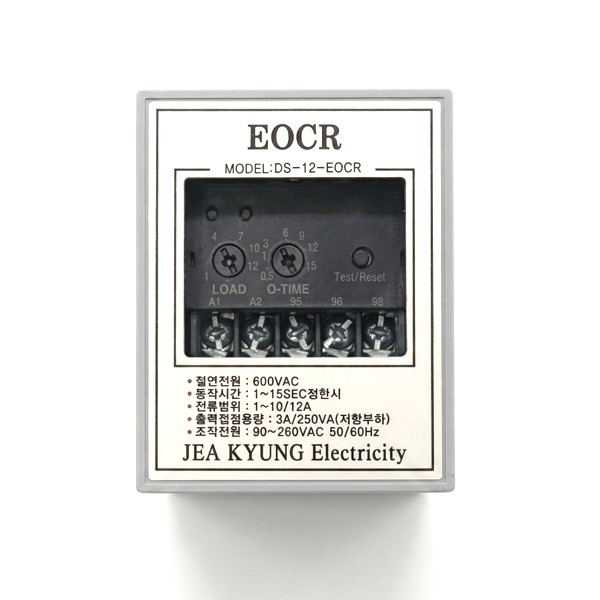

- Top 1·2·3 (input) — the three main-circuit phases (L1·L2·L3) from the MCCB's output land here.
- Bottom 7·8·9 (output) — the same current exits straight down to the MC's main contacts. 1↔7 · 2↔8 · 3↔9 are always hard-wired together — current literally passes through.
- While it passes, an internal current transformer (CT) reads each phase's current in real time.
So every motor-protection circuit has the same backbone — MCCB → EOCR → MC → motor — every amp the motor draws has to cross the EOCR first.
Trip contact (10 COM · 4 NC · 5 NO) — where the overload signal leaves

The trip contact is how the EOCR tells the outside world "this motor is overloaded." It's the same single-body SPDT you saw on the 8-pin relay.
- 10 (COM) — the common pole; the entry the signal flows in through, regardless of state.
- 4 (NC) — closed at rest, opens on trip. Wire it into the MC coil's leg and an overload breaks the coil circuit → the motor stops on its own. The heart of "overload → auto-stop."
- 5 (NO) — open at rest, closes on trip. For alarm output — a red lamp (RL) or buzzer hung here fires the instant a trip happens.
See it work


In the simulator, switch the MCCB on and hold PB1 and the three phases run POWER → MCCB → EOCR → MC → motor. Click the EOCR body while holding to fake an overload trip — the moment 10-4 opens, you'll watch the motor stop on its own.
Next
EOCR acts on current. Next comes the sibling that acts on time — the timer (T), whose contacts flip only after a configured delay following coil energization.
Try it yourself
Trip an EOCR and watch the motor stop in the Korean Electrician practical simulator →