Korean Electrician Glossary — MCCB, MC, EOCR, TB Explained
The Korean Electrician (전기기능사) practical schematics are full of part abbreviations like MCCB, MC, EOCR and wiring terms like self-hold, interlock, pass-through wiring. This page collects the ones people mix up most, defines each in a line, and links straight to the guide that covers it in full. Look a term up here first when one trips you up.
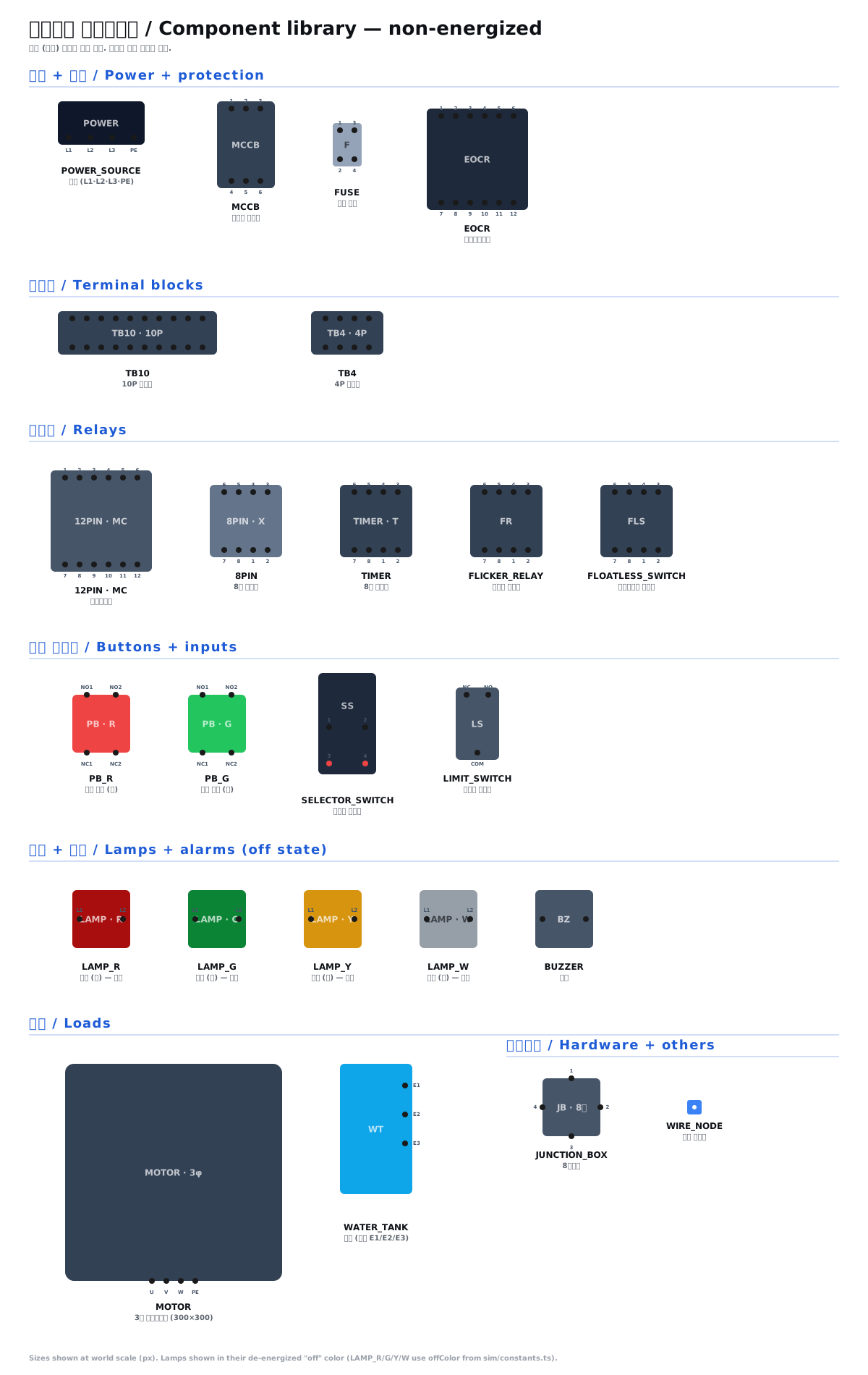
Power & protection
| Term | Meaning |
|---|---|
| MCCB (molded-case circuit breaker) | Switches the main circuit on/off at the panel entry and trips on overcurrent or a short. → MCCB & fuse |
| Fuse | Overcurrent protection for the control circuit. Wire colour switches from the main circuit to the control circuit (yellow) at this point. → MCCB & fuse |
| EOCR (electronic overload relay) | Watches the motor current and breaks the circuit through its trip contacts when an overload occurs. → EOCR overload relay |
| PE (protective earth) | Protective conductor providing a fault-current path for protective disconnection; distinct from neutral N. → Supply and contacts |
Switching & control parts
| Term | Meaning |
|---|---|
| MC (magnetic contactor) | A large relay whose mains contacts close when the coil energises, feeding 3-phase to the motor. Its aux contacts handle self-hold and interlock. → Magnetic contactor (MC) |
| Relay (8-pin relay) | A control switch where the coil (2·7) drives two contact sets (1-3-4 / 8-6-5) at once. → 8-pin relay |
| Timer (T, time-delay relay) | This lesson’s on-delay model has timed contacts and separate instantaneous contacts; check the device mode. → Timer relay |
| FR (flicker relay) | Cycles its contacts on/off at a fixed interval to make a lamp blink. → Problem 1 analysis |
| FLS (floatless switch) | A liquid-level relay that starts and stops a pump based on water level. → Problem 1 analysis |
| LS (limit switch) | A position/detection switch. Problem 14 uses two inputs for AND/OR conditions; contact arrangements vary by device. → Problem 14 logic |
| SS (selector switch) | A turn-knob switch for choosing the run mode — manual, auto, and so on. → Problem 1 analysis |
| PB (push button) | A self-returning contact that acts only while pressed. Red = stop, green = start. → Sequence control & contacts |
Contacts & signals
| Term | Meaning |
|---|---|
| a-contact (NO · normally open) | Open at rest, closes when pressed. Used for start/run signals. → Sequence control & contacts |
| b-contact (NC · normally closed) | Closed at rest, opens when pressed. Used for stop. → Sequence control & contacts |
| Self-hold | Wiring a relay/MC a-contact in parallel with the start button so the action holds after you release it. → The self-hold circuit |
| Interlock | A circuit arrangement preventing incompatible operations. Apply it where the circuit requires it; problem 14 is not a reversing circuit. → MC contacts |
| GL·RL·YL (indicator lamps) | Green/red/yellow lamp labels. Read their meaning from the circuit; GL indicates M2 running in problem 14. → Indicators |
| BZ (buzzer) | An output device that signals a fault or alarm with sound. → Problem 1 analysis |
Wiring & terminal terms
| Term | Meaning |
|---|---|
| TB (terminal block) | A connection terminal that joins wires inside and outside the panel — e.g. TB10 on the motor row, TB4 on the power row. → Motor & terminal blocks |
| 2 wires per terminal | The cited exam prohibits three or more conductors at one terminal. Actual terminal capacity also depends on its specification. → Wiring rules |
| Pass-through wiring | Route a connection via a suitable terminal on the same electrical node, not just any spare pole. → Wiring rules |
| Wire-colour rule | Main circuit L1 brown · L2 black · L3 gray; control circuit yellow; PE green-yellow. → Wiring rules |
| Main vs control circuit | The heavy circuit feeding power to the motor vs the light circuit that decides the logic. The fuse is the boundary. → MCCB & fuse |
| Saddle | The bracket that fastens conduit to the panel or wall. Two fixing-position rules apply. → Conduit & piping |
| Pulling wire (통선) | The finishing step of running wires through the conduit. → Conduit & piping |
Layout & exam terms
| Term | Meaning |
|---|---|
| Control panel | The 400×420mm plywood board on which every part is mounted and wired. → Panel layout rules |
| Tolerance | ±5mm for parts on the board, ±30mm for parts off it. Large cumulative error leads to disqualification. → Panel layout rules |
| Public problem | An officially published practical task. Problem 14 compares two-motor AND/OR input conditions. → Problem 14 |
| Disqualification | Conditions excluded from marking under the official task instructions; consult the applicable edition. → Wiring instructions |
| Conduit work | The piping, box and cable work that joins the finished panel to the field. → Conduit & piping |
Browse all guides
To learn each term in order — from the idea to the wiring — follow the full Korean Electrician study guide index. New here? Start with sequence control & contacts.
Try it yourself
Open the practical project list →
Check your understanding
Question: Are PE and N interchangeable terms?
Answer: No. PE is the protective conductor and N is neutral. The L1/L2/L3/PE example does not show a neutral.
Practice path and references
The practical project list may require sign-in. Create a project, choose a task and place the relevant components, then compare the contact/wiring paths explained here. The link does not preload a specific completed circuit.
Reference: Q-Net public-problem notice, 2025-08-04 edition, problem 14 pages 11-1 to 11-4 (work/wiring instructions) and 11-9 (component diagrams). Read the original for each task and any amendments. Site examples are distinct from general installation design requirements.