What Is a Self-Holding Circuit? Principle and Wiring Explained
A push-button only conducts while you hold it. A motor, though, has to keep running after the operator lets go. So you need a circuit that stays on after the button is released — that is the self-holding circuit. Almost all 18 public practical-exam problems are built on it.
First: a relay's coil moves its contacts
When current flows through the coil, the internal contacts all switch at once. That action is the starting point for self-hold.


- Coil: pin 2 · pin 7
- First contact set: 1 (COM) · 3 (a/NO) · 4 (b/NC)
- Second contact set: 8 (COM) · 6 (a/NO) · 5 (b/NC)
The principle: an a-contact in parallel with the button
It comes down to one line: wire the relay's own a-contact in parallel with the start button.
- Press the button and the coil energizes, closing its own a-contact.
- That closed a-contact creates a new current path that bypasses the button.
- So even after you let go, current keeps flowing to the coil through the a-contact.
The three-stage formula
- Start — L1 → start button (a-contact) → coil → L3. Runs only while held.
- Self-hold — wire the relay's a-contact in parallel with the start button. One press and it stays latched.
- Stop — insert the stop button's NC contact in series. Pressing it breaks the path and releases the latch.
Start = a-contact in parallel, stop = NC contact in series. Those two lines are the whole formula.
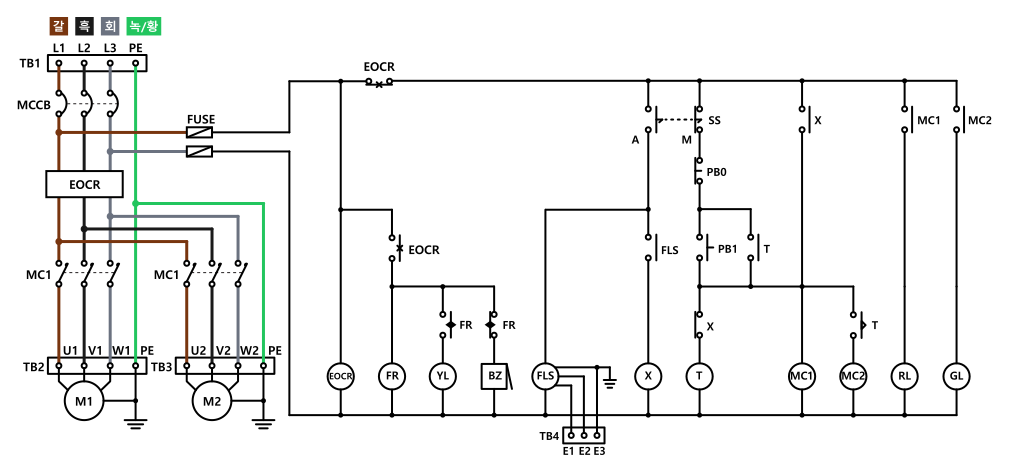
Seen in a real exam circuit
A public problem's control circuit is, at its core, this same self-hold latch with indicator lamps and interlocks layered on top.
Common mistakes
- Wiring the stop button as an a-contact → stop must be an NC contact in series.
- Putting the a-contact in series with the coil → it must be in parallel for self-hold to work.
- Three wires on one terminal → automatic fail. See the terminal-wiring rules guide.
Try it yourself
Wire a self-hold circuit in the Korean Electrician practical simulator →