What Are a-Contacts and b-Contacts? Sequence Control Basics
Sequence control means a circuit makes decisions in a fixed order — *"input arrives → the circuit decides → an output fires."* Traffic lights, elevators, and motor starters all follow the same pattern. Every public problem on the Korean Electrician practical exam is built on this flow, so let's start where it starts: the supply, contacts, and push-buttons.
The supply — three-phase, four wires, and color
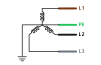
- L1 brown · L2 black · L3 gray — together the three lines form a three-phase supply, creating the rotating magnetic field that turns a motor's shaft.
- PE green — protective earth. It carries no current in normal use; if a live conductor touches a metal enclosure during a fault, PE diverts the leakage to ground so no one is shocked.
The full wire-color rule by circuit type is covered in Wire color & terminal rules.
a-contacts and b-contacts — the circuit's on/off
Every decision in sequence control reduces to *"is this contact closed or open?"* There are two basic types.


- a-contact (NO) — open at rest, closes when pressed. Used for start / run signals.
- b-contact (NC) — closed at rest, opens when pressed. Used for stop. (This is why the stop in a self-hold circuit is a b-contact.)
Push-buttons — momentary, and the color convention
A push-button is a spring-return (momentary) contact: it acts only while held, and the internal spring snaps it back the instant you let go. Usefully, one button body houses both contacts at once — the top two terminals (NO) are the a-contact, the bottom two (NC) are the b-contact.
The color convention is a shop-floor standard:
- Red button (PB0) = stop / emergency, green button (PB1) = start / normal.
- Indicator lamps follow the same rule — red = run/fault, green = stop/normal, yellow = warning, white = power applied.
See it work


- Hold the green button (PB1) and its a-contact closes, lighting the green lamp (GL).
- Hold the red button (PB0) and its b-contact opens, darkening the red lamp (RL).
- Let go and the spring returns the contacts to rest.
Next
A button only acts while held. To keep something running after you let go, you need a relay. Next up: the 8-pin relay — how a coil moves its contacts — and the self-holding circuit you build from it.
Try it yourself
Press the buttons in the Korean Electrician practical simulator →